
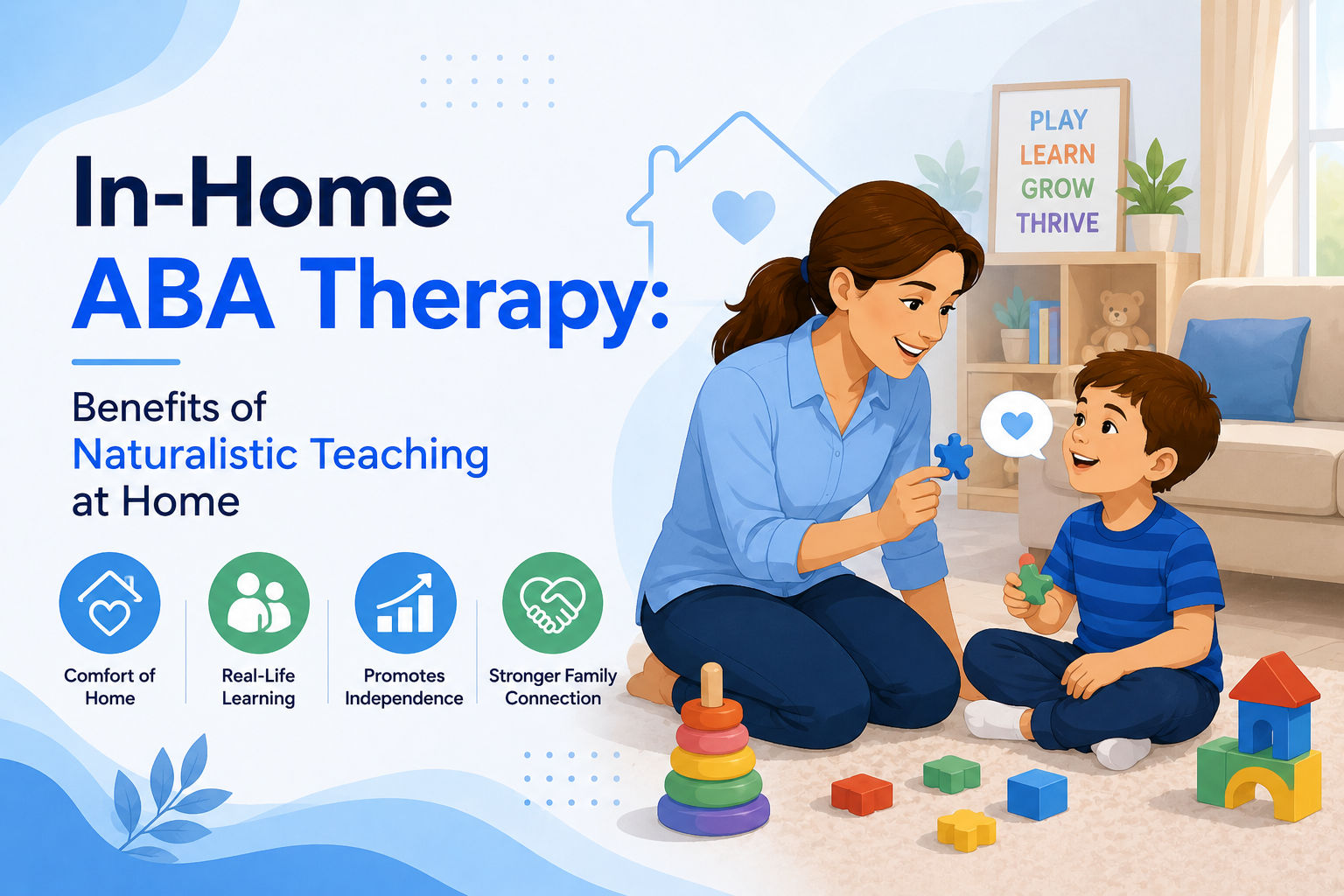
There is a psychological phenomenon researchers call context-dependent learning. The brain encodes what it learns alongside the sensory environment where learning happened.
In-home ABA therapy exists because of this phenomenon. Not as a convenience. As a clinical advantage that no clinic setting can replicate.
And for families watching their child fall apart the moment the school day ends, that advantage is worth understanding deeply.
The Context Problem That Clinic-Based Therapy Cannot Solve
Why Skills Learned at a Table Stay at the Table
A child who learns to request a snack at a therapy table, in a room designed to minimize distraction, using materials chosen by a clinician, has learned something genuinely useful. But they have learned it attached to that specific context.
The sensory cues of the clinic. The specific therapist. The particular chair. The brain stores all of it as part of the memory. Home-based ABA therapy disrupts this limitation by placing learning exactly where the skill will actually be used.
What Generalization Really Requires
Generalization, meaning the ability to use a skill across different people, settings, and materials, is one of the most demanding developmental tasks for children on the autism spectrum.
Research from the Journal of Applied Behavior Analysis consistently shows that naturalistic teaching approaches produce stronger generalization outcomes than structured discrete trial training alone. The reason is straightforward. When a skill is practiced in the kitchen during actual breakfast, it stays in the kitchen during actual breakfast.
ABA therapy at home removes the transfer problem at the source. There is no gap between where the skill was learned and where it needs to function.
What In-Home Autism Therapy Actually Looks Like
A Morning Routine Becomes a Curriculum
A skilled in-home ABA therapist does not arrive with a binder of worksheets and sit down at a separate table.
They walk into the morning routine and see a learning environment. The transition from pajamas to school clothes. The resistance at the bathroom door. The eight seconds of eye contact that happened over breakfast and can be extended to ten. Every ordinary moment carries therapeutic potential.
In-home autism therapy is built around these moments. Not around interrupting them.
The Sensory Reality of Home
Home carries a sensory signature that no clinic can replicate. The specific smell of the house. The familiar texture of the couch. The sound of a sibling’s voice from the next room.
For children with autism, these sensory anchors are not distractions. They are stabilizers. In-home ABA therapy uses this stabilizing familiarity as a foundation for introducing challenge and building tolerance.
A child who is regulated by their environment is a child who can learn. That is the clinical logic behind every home-based ABA therapy program designed by qualified behavior analysts.
What NET ABA Therapy Is and Why It Changes Everything
Naturalistic Environment Teaching Explained
NET ABA therapy, which stands for Naturalistic Environment Teaching, is the specific methodology that in-home ABA therapy draws on most heavily.
It differs from structured discrete trial training in one fundamental way: the learning opportunity is not created by the therapist. It is found in what the child is already doing and motivated by. The therapist follows the child’s lead and embeds instruction within activities the child has already chosen.
A child who wanders to the bookshelf is being offered a communication opportunity, a turn-taking opportunity, and a joint attention opportunity simultaneously. NET ABA therapy trains therapists to see and use all three without interrupting the child’s natural engagement.
Why Child-Led Learning Produces Faster Results
Children learn fastest when they are intrinsically motivated. This is not controversial developmental psychology. It is observable in every classroom, every playground, and every well-designed ABA therapy at-home session.
NET ABA therapy capitalizes on natural motivation by pairing instruction with activities the child already loves. That alignment between teaching and wanting produces faster skill acquisition, stronger retention, and more genuine generalization than any amount of structured table work alone.
The Problems Home-Based ABA Therapy Solves That Clinics Cannot
Behavior That Only Happens at Home
Some behaviors are environmentally specific. The child who melts down during the morning routine at home but holds it together at school is not inconsistent. They are responding to different environmental conditions with different behavioral patterns.
A clinic-based therapist will never see that meltdown. They will never identify the antecedent that precedes it, the consequence pattern that maintains it, or the environmental modifications that might prevent it.
Home-based ABA therapy puts the therapist in the room where the behavior actually happens. That changes everything about the quality of the assessment and the precision of the intervention.
Transition Problems Require Transition Practice
Transitions are among the most common and most distressing behavioral challenges in autism. Moving from a preferred activity to a non-preferred one. Getting from the car to the classroom. Shifting from free play to structured time.
ABA therapy at home allows therapists to practice transitions in the actual transition environments. Not role-played transitions in a therapy room. The actual hallway. The actual car door. The actual moment when the TV needs to go off. That specificity is what makes the progress stick.
Parent Involvement: The Factor That Multiplies Everything
The 165-Hour Gap Nobody Talks About
A therapist providing in-home autism therapy might work with your child for three to five hours per week. There are 168 hours in a week.
The quality of the remaining 165 hours determines whether therapy gains accumulate or erode. That is not a criticism of parents. It is the single most important variable in the entire treatment equation.
In-home ABA therapy addresses this gap directly through parent coaching embedded in every program. Parents learn to recognize the same moments the therapist sees. They learn when to prompt, when to wait, and how to respond in ways that support the behavioral plan rather than inadvertently working against it.
What Parent Coaching Actually Teaches
Parent coaching in ABA therapy at home is not about turning families into clinicians.
It is about teaching parents to read the behavioral landscape of their own home with new eyes. To notice the antecedent that always precedes the meltdown. To understand why certain responses strengthen the behavior they were trying to stop. To know when a skill is close to emerging and how to give it just enough support to break through.
These are learnable skills. And learning them transforms the home from a setting where behavior problems happen into an environment where growth continuously occurs.
What to Realistically Expect From In-Home ABA Therapy
The First Month Looks Like Research
The initial weeks of any home-based ABA therapy program are heavy on observation and assessment.
A BCBA from The Behavior Architects will map your child’s behavioral patterns within the home environment, identify the functions behind the most challenging behaviors, and build a program around what your child and family actually need. This is not a generic protocol applied to every child who walks through the door.
Progress Is Specific, Not Spectacular
By month three, families typically describe changes in the specific friction points of daily life.
Mornings run more smoothly. The after-school meltdown has a shorter duration. A child who could not initiate play with a sibling now does so with a prompt. These gains are not the dramatic breakthroughs that make for compelling social media posts. They are the real, durable changes that make daily life genuinely better.
The Behavior Architects delivers in-home ABA therapy and in-home autism therapy across the Detroit area with programs built entirely around each child’s specific environment, behavioral profile, and family goals.


