
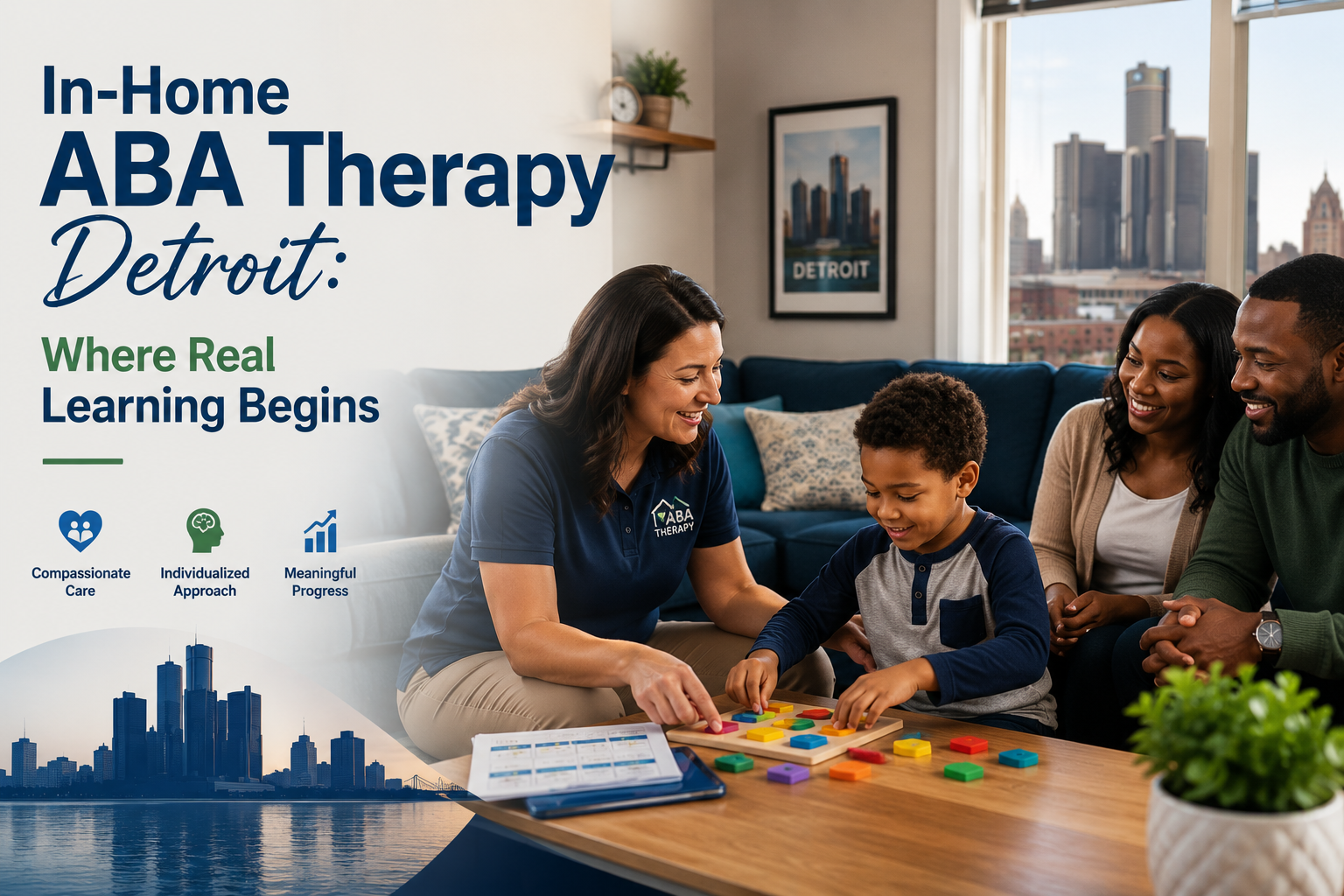
A parent’s guide to understanding ABA in the environment that matters most
Every parent of a child with autism has experienced a major mood shift within a day. The child who held it together all morning at the clinic falls apart within minutes of walking through the front door. Or the reverse happens.
Your child seems calm, focused, and connected at home, but the moment they step into a structured setting, everything shifts. These contradictions are not random. They are meaningful, and they deserve a meaningful response.
In-Home ABA Therapy Detroit is all about catering those contradictions by bringing skilled therapeutic support into the space where your child already lives.
ABA Autism Therapy: What It Actually Looks Like in Practice
Most descriptions of ABA autism therapy start with definitions. That is the wrong place to begin. Definitions do not tell you what it feels like to watch your child struggle to ask for a snack, or what it means when a therapist sits on the kitchen floor and follows your child’s lead for twenty minutes.
Applied behavior analysis works by examining the relationship between a behavior and what surrounds it. That means looking at what happened before the behavior, the behavior itself, and what followed.
These are called antecedents, behaviors, and consequences in behavioral science. But in practice, it means a therapist observing your child throw a toy during a transition and asking not “what is wrong with this child” but “what is this child trying to communicate?”
Replacing the Myth with the Mechanism
A child who throws toys when frustrated is not misbehaving in any simple sense. They may lack the language or the signal to say “I am overwhelmed” or “I do not want to stop.”
The behavior becomes their loudest available option. ABA autism therapy works to expand the range of options, not to eliminate the child’s instinct to communicate.
This is where the misconception about ABA most commonly appears. Many parents arrive with the fear that ABA is about compliance, about making a child sit still and repeat tasks.
Modern, ethical ABA therapy is about understanding the function of behavior and building alternatives that serve the same need more effectively.
Week 1 vs. Week 12: A Real Look at Progress
In the first week of in-home therapy, much of what the therapist does is observe. They watch how your child moves through the morning routine. They note what triggers a shutdown, what sparks engagement, and where the biggest communication gaps sit.
By week twelve, something often shifts. Not dramatically, not in ways that look like a movie montage.
A child who used to drop to the floor when asked to stop watching a video might now accept a five-minute warning with a visual timer. A child who hits during transitions might now reach for a parent’s hand instead.
These are small pivots with large implications.
- Behaviors are studied in context, not isolated from it
- Antecedents reveal what makes a behavior more or less likely
- Consequences shape whether a behavior continues or fades
- Progress is tracked across settings, not just during sessions
Naturalistic ABA: Learning Woven into Daily Life
There is an older version of ABA that most critics are referring to when they raise concerns. That version involved long hours at a table, repetitive drills, and very little connection to how a child actually lived their life. That model has been substantially reformed. Naturalistic ABA is now the approach that most skilled therapists use, and it looks remarkably different.
Old Structure Versus Real Life
Naturalistic ABA does not wait for a session to begin. Learning happens during snack time when a child gestures toward the crackers and the therapist creates a moment to model the word. It happens during sibling play when the therapist coaches turn-taking without stopping the game. It happens in the hallway when a child is putting on shoes, and a therapist uses that two-minute window to practice the sequence.
The distinction matters because generalization, the ability to use a skill across different settings, is one of the hardest things for many autistic children to achieve. When skills are only practiced at a table with flashcards, they often stay at the table. When they are practiced during the actual morning routine, in the actual kitchen, with the actual sensory experience of home, they tend to stick.
Parent Training Is Not Optional
One of the most underemphasized parts of quality ABA therapy is parent training. The therapist is in your home for a certain number of hours each week. The rest of the week, you are there. That is not a gap in service. It is an opportunity, if you are equipped to use it.
Parent training in naturalistic ABA means learning to see the same moments the therapist sees. It means knowing when to prompt and when to wait. It means understanding how to respond when a behavior occurs so that your response supports the plan rather than accidentally undermining it.
This is not about turning parents into therapists. It is about making the whole environment therapeutic.
- Naturalistic ABA follows the child’s attention, not a script
- Teaching moments are embedded in meals, play, and daily transitions
- Parent coaching extends therapeutic gains across all waking hours
- Skills practiced at home transfer more reliably than clinic-only learning
What Parents Should Realistically Expect
This section exists because too many parents have been either frightened away from ABA or sold on it unrealistically. Neither extreme serves your child.
In-home ABA therapy is a commitment. It requires consistency from your household. It requires you to participate actively rather than handing your child over to a therapist and hoping for the best. There will be sessions where progress feels invisible. There will be weeks where a skill your child mastered seems to disappear. This is normal, and it is part of the process.
What skilled in-home ABA therapy offers is a systematic way of understanding your child’s behavior and building toward greater independence and communication.
That is worth something specific, not everything, but something real. If you are considering this path for your family, reach out to The Behavior Architects to ask informed questions before you commit.


