
Why the most effective learning often looks nothing like a therapy session
Everyday situations play a bigger role in child development than most people realize. Simple actions, like reaching for an item in a grocery store or reacting to a new environment, can reflect how a child processes sensory input, communicates needs, and manages change.
Applied Behavior Analysis Detroit providers increasingly focus on these real-life moments, using them to build practical skills that carry over beyond structured sessions.
Naturalistic ABA Therapy: When the Setting Is the Teacher
Naturalistic ABA therapy does not begin at a table. It does not begin when a therapist opens a bag and arranges materials. It begins the moment a child enters a space that contains the ordinary textures of their life: the noise, the motion, the expected and unexpected demands of being in the world.
Back to the Grocery Store
In the story above, a skilled therapist accompanying that family does not redirect the child away from the cereal box. They move toward it. They pause beside the child, wait, and use that moment of genuine engagement to create a communicative opportunity. “Shake,” the therapist says, not as a command, but as a label, timed to the exact moment the child performs the action.
The child looks up. Not because they were asked to. Because the word arrived precisely when the experience did, and the match registered. That is naturalistic ABA therapy in its simplest form. The teaching moment is borrowed from real life rather than constructed in isolation.
What Just Happened: The Behavioral Science Underneath
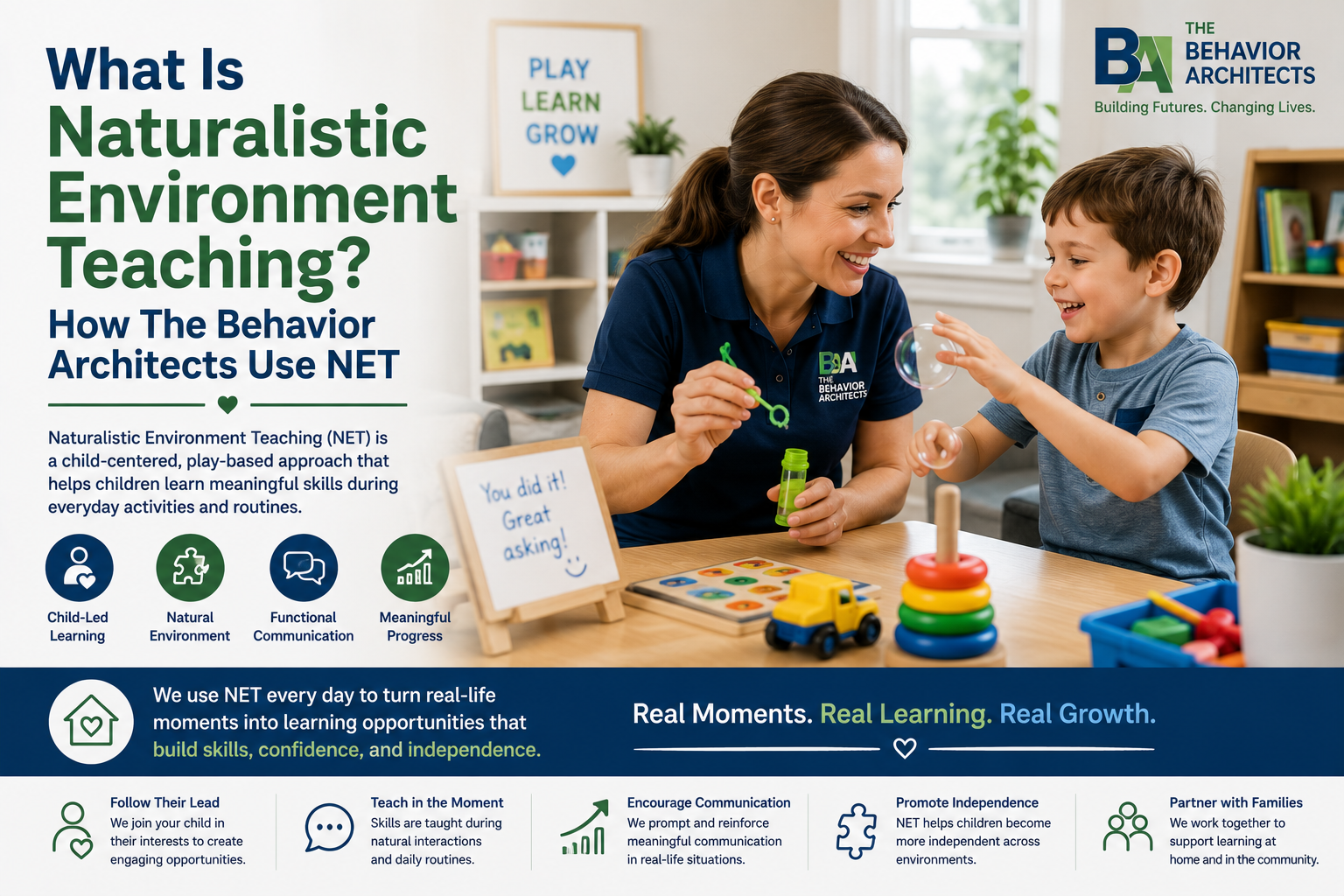
Pausing the story for a moment reveals the mechanism. Naturalistic environment teaching (NET) works by identifying naturally occurring reinforcers, the things a child already finds interesting or enjoyable, and using them as the context for learning.
Instead of a therapist presenting a flashcard of a cereal box and asking “what is this?”, the real box, the real action, the real sensory experience does the teaching.
This approach draws on principles from incidental teaching, pivotal response training, and the broader framework of naturalistic developmental behavioral interventions. The underlying logic is that motivation drives attention, and attention is the prerequisite for learning. Finding what a child is already motivated by and teaching within that context reduces the effort required to create engagement.
- Natural reinforcers are more powerful than artificial rewards for many children
- Learning within context supports generalization across settings
- Child-initiated activities increase motivation to communicate
- Teaching is embedded in the moment rather than scheduled around it
Autism Therapy Detroit: Where This Approach Lives
Autism therapy Detroit families are looking for does not happen only in dedicated clinic rooms. Naturalistic environment teaching is particularly well-suited to the home, community, and school environments where children spend the majority of their time. The grocery store, the playground, the kitchen table, the back seat of the car: these are all viable teaching environments for a skilled practitioner.
The Story Continues
Back in the grocery store aisle, the child has now been handed the cereal box. The therapist waits. The child shakes it again and then looks at the therapist. This is called a communicative look, a bid for shared attention. The therapist responds: “You like that sound.” The child reaches for another box on the shelf.
Nothing about this looks like therapy in the conventional sense. There is no table, no chair, no reinforcement chart visible. But the therapist is tracking the child’s initiations, identifying what captures sustained attention, and building a picture of what will drive engagement in future teaching moments. The session has structure. It is just structure that moves with the child.
Why Some Children Respond Better to NET
Children who struggle with transfer, the ability to take a skill learned in one setting and apply it in another, often show better outcomes when skills are taught in the environments where they will ultimately be used. Children who find structured clinic settings dysregulating may access learning more readily in familiar environments. Children with strong sensory preferences often engage more deeply when those preferences are incorporated into the teaching context rather than managed away from it.
NET is not the right fit for every child and every skill. Some children thrive with more structured discrete trial teaching for specific targets. The most effective therapy programs use a blend, choosing the approach based on what the child needs to learn and where they are most able to access that learning.
- Children with generalization challenges benefit from in-environment teaching
- Sensory and motivational preferences are incorporated rather than minimized
- NET can be combined with structured approaches based on individual goals
- Progress is tracked across natural settings, not just clinical conditions
The Same Child, a Different Moment
Return to the grocery store one more time, three months later. The same child, the same aisle, the same cereal box. This time, before reaching for the box, the child turns toward the parent and raises their hand, an approximation of “can I have that?” It is not a full sentence. It is not even a full word. But it is a reach toward communication that did not exist three months ago.
The parent pauses, moves the box to where the child can reach it, and says “cereal.” The child takes it and shakes it once, purposefully, then puts it in the cart. The meltdown that used to follow the transition away from that box does not come.
Naturalistic environment teaching works because it treats the whole world as a classroom. It respects what the child is already doing and builds from there. When therapy is woven into life rather than separated from it, children do not have to cross a border between “therapy mode” and “real life.” They simply live, and within that living, they grow.
To learn how The Behavior Architects incorporates naturalistic environment teaching into individualized therapy programs across Detroit, reach out to begin the conversation.


