
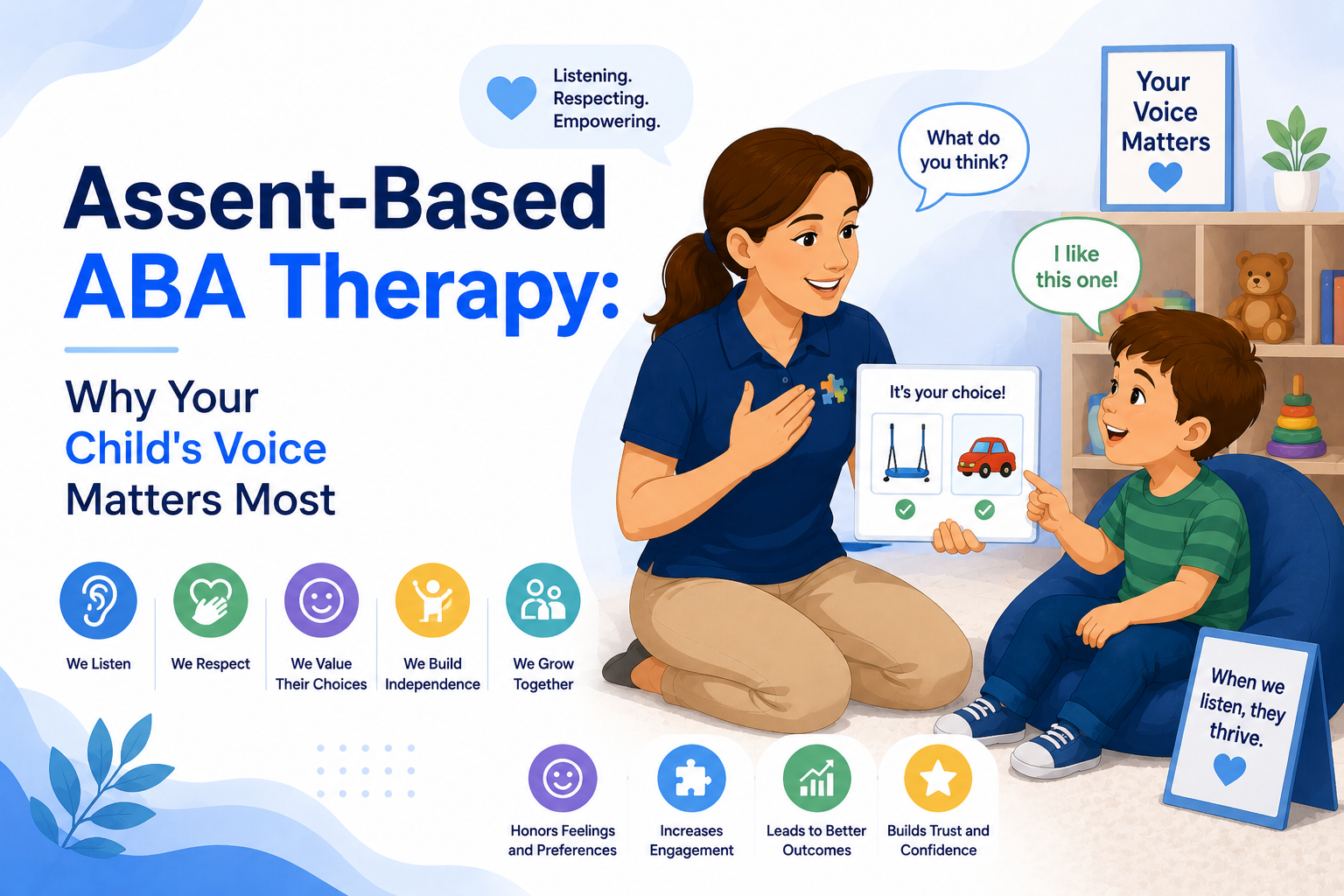
Here is a question most intake paperwork never asks: does your child actually want to be in this room, doing this thing, with this person?
Assent-based ABA therapy is built on the premise that the answer to that question matters clinically, ethically, and practically. It is not a soft philosophy layered onto behavioral science. It is a fundamental shift in how therapy is designed, delivered, and evaluated.
And for families who have watched their child shut down inside a clinical setting, it is an explanation worth understanding fully.
The Problem With Compliance-Focused Therapy
When Cooperation Looks Like Progress but Isn’t
For decades, a certain version of ABA therapy measured success by compliance.
Could the child sit?
Could they follow the instructions?
Did they complete the task?
Compliance is easy to measure and dangerously easy to mistake for genuine learning. A child who complies with a request because the consequence of not complying is aversive has learned something very specific: that refusing is not safe. That is a trauma response, not a therapeutic gain.
Assent in ABA recognizes this distinction and treats it as clinically significant.
What Happens When Discomfort Is Ignored
Children who experience repeated sessions that override their clear signals of distress do not simply become less distressed over time.
Research published in the journal Behavior Analysis in Practice has examined the relationship between coercive therapy practices and long-term emotional outcomes in autistic individuals. The findings are consistent with what trauma-informed practitioners have long observed. Forced participation does not produce the generalized, motivated learning that ethical ABA therapy is designed to achieve.
It produces a child who has learned to suppress their own signals. That outcome is the opposite of what treatment should do.
What Assent-Based ABA Therapy Actually Means
Assent Is Not the Same as Consent
Legal consent for a child’s therapy belongs to the parent or guardian. That is not what assent addresses.
Assent in ABA refers to the ongoing behavioral signals a child gives that indicate whether they are willing, engaged, and regulated enough to participate meaningfully in a session. These signals do not require verbal language. They require a therapist trained to read them.
A child who turns away, goes limp, begins engaging in repetitive self-soothing behavior, or simply stops responding is communicating clearly. Assent-based ABA therapy requires therapists to read that communication and respond to it by adjusting, pausing, or changing the approach.
What Assent Looks Like in a Real Session
In a session guided by ethical ABA therapy principles, the therapist is continuously monitoring the child’s affective state alongside their behavioral responses.
Is this child engaged? Are they moving toward the activity or away from it? Does the pace of instruction match their current regulatory state? Child-centered ABA therapy uses these questions as real-time clinical data, not as obstacles to getting through the session plan.
When a child signals that they are at their limit, a skilled therapist honors that signal and uses it to design a better pathway forward. That responsiveness is not permissiveness. It is precision.
The Neuroscience Behind Why Assent Matters
Stress and the Capacity to Learn
The brain’s stress response system and its learning system share real estate in ways that matter enormously for therapy.
When a child is in a state of significant distress, the prefrontal cortex, the part of the brain responsible for executive function, language, and learning, becomes less accessible. The limbic system, which manages threat response, takes priority. A child in that state is not in an optimal state to acquire new skills.
Ethical ABA therapy that attends to the child’s internal state is not less rigorous. It is being more neurologically informed.
Why Positive Behavior Support and Assent Work Together
Positive behavior support is a framework that emerged from ABA and shares many of its core principles. It emphasizes preventing challenging behaviors through environmental design rather than responding to them after the fact.
When assent-based ABA therapy and positive behavior support are integrated, the result is a therapeutic environment that works with the child’s nervous system rather than against it. Challenges become less frequent because the environment and the pace are calibrated to what the child can actually handle.
What Child-Centered ABA Therapy Looks Like in Practice
Following the Child’s Lead
Child-centered ABA therapy begins every session by reading what the child brings to the room. Their energy, their regulatory state, their current interest, their tolerance for demand.
The session is then shaped around what that child can engage with meaningfully right now, not around what the session plan says should happen today. This does not mean abandoning goals. It means pursuing goals through pathways that the child is actually willing to walk down.
A therapist who can find ten different routes to the same skill target is a better therapist than one who can only reach it one way. Assent-based ABA therapy demands that level of clinical creativity.
What Happens When a Child Says No
In assent-based practice, a child’s clear refusal is not an obstacle to be overcome. It is information.
The therapist’s job is to understand what the refusal communicates. Is the child overstimulated? Was the previous demand too high? Is there a sensory issue in the environment? Does the child need a different kind of reinforcement? Each of these has a different solution, and ethical ABA therapy requires identifying the right one rather than defaulting to compliance strategies.
How Assent in ABA Builds Better Long-Term Outcomes
Trust Is a Therapeutic Variable
When children experience therapy as something that happens with them rather than to them, something changes in the therapeutic relationship.
They begin to anticipate sessions with less anxiety. They initiate interaction with therapists more readily. Their engagement becomes genuine rather than performed. Assent in ABA is not just an ethical requirement. It is a clinical accelerant.
What the Research Actually Shows
Studies examining the outcomes of child-centered ABA therapy approaches consistently show that intrinsically motivated learning produces stronger skill acquisition and more robust generalization than compliance-based approaches.
The child who learns a skill because they wanted to engage with the activity that embedded it retains that skill more reliably than the child who learned it under pressure. That research finding is not separate from assent in ABA. It is the mechanism that explains why assent matters.
The Ethical Obligation That Is Also a Clinical One
Doing the Right Thing Produces Better Results
Ethical ABA therapy is not about sacrificing clinical effectiveness for compassion. It is about recognizing that genuine compassion and genuine clinical effectiveness are pointing in exactly the same direction.
A child who trusts their therapist, who feels safe enough to try something hard, and who experiences therapy as a place where their signals are respected and heard is a child who learns faster, retains more, and generalizes better. That is the promise of assent-based ABA therapy fully delivered.
Positive behavior support, ethical practice, and genuine child-centered ABA therapy are not alternative philosophies. They are the same philosophy expressed through different lenses.
The Behavior Architects practice assent-based ABA therapy and child-centered ABA therapy with every client, building programs that children participate in willingly because they are designed to be worth participating in.


