
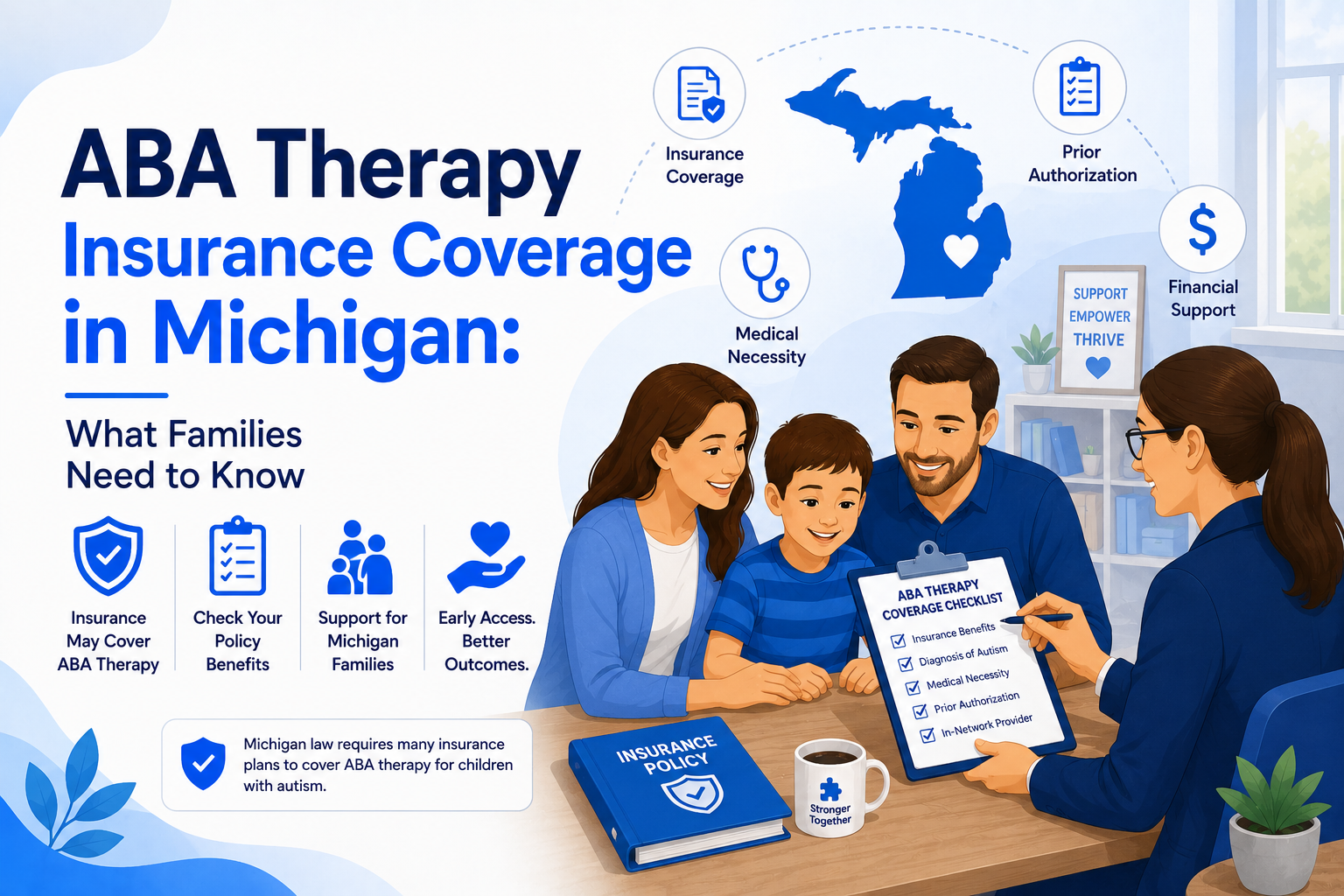
Most families learn about ABA therapy first. Then they ask the question that stops everything: can we actually afford this?
ABA therapy insurance coverage in Michigan is broader than most families realize, and the barriers that feel insurmountable are often navigable with the right information.
This is that information.
Why Insurance Coverage for ABA Exists at All
The Federal Mandate That Changed Everything
Before 2014, ABA therapy was treated by most insurers as an experimental or educational service rather than a medical one. That classification kept it out of coverage for the majority of families who needed it.
The Affordable Care Act changed the landscape fundamentally. By classifying autism spectrum disorder as a covered essential health benefit, the ACA created a pathway for ABA therapy insurance coverage across all states through plans sold on the marketplace. Michigan followed with its own parity law requiring state-regulated plans to cover autism therapy insurance without arbitrary caps.
What Parity Laws Actually Require
Mental health parity legislation requires that insurance plans cover behavioral health treatment on the same terms as physical health treatment.
In practice, this means that ABA therapy for autism cannot be subject to visit limits, prior authorization hurdles, or cost-sharing arrangements that would not be applied to an equivalent medical service. That legal protection exists for families in Michigan, and understanding it changes how you navigate the authorization process.
Michigan Medicaid ABA: What Families With Medicaid Need to Know
EPSDT and Why It Matters
Michigan Medicaid covers ABA therapy for children through the Early and Periodic Screening, Diagnostic, and Treatment benefit, known as EPSDT.
EPSDT requires Medicaid to cover any service that is medically necessary for a child under 21, regardless of whether that specific service is listed in Michigan’s general Medicaid plan. This is a federal requirement, not a discretionary benefit. Michigan Medicaid ABA coverage for children is legally mandated when there is medical necessity documentation.
How to Establish Medical Necessity for Michigan Medicaid ABA
Medical necessity for ABA therapy is established through a formal autism diagnosis from a licensed psychologist or developmental pediatrician, combined with a functional behavioral assessment that demonstrates the child’s need for behavioral intervention.
Michigan Medicaid ABA requires this documentation to be submitted during the prior authorization process. The authorization covers a specific number of hours over a defined period, after which a progress review determines whether continued services are medically necessary.
Private Insurance and ABA Therapy Coverage in Michigan
What Your Plan Is Actually Required to Cover
Michigan’s autism insurance law, Public Act 141 of 2012, requires most private insurance plans in Michigan to cover ABA therapy costs as part of behavioral health treatment.
Fully insured plans regulated by the state must cover ABA services with no lifetime dollar limits and no age caps above what applies to other medical conditions. This covers the majority of employer-sponsored plans and individual marketplace plans. It does not cover self-funded employer plans, which are regulated federally and not by state law.
The Prior Authorization Process Explained
Prior authorization for ABA therapy insurance coverage requires a formal diagnosis, a treatment plan developed by a BCBA, and documentation supporting medical necessity. The insurer then approves a specific number of therapy hours over a defined period.
Most families encounter their first frustration here. Insurers sometimes request additional documentation, require peer reviews, or issue initial denials that are intended to be appealed. Understanding that the first authorization request is often not the final answer prevents families from accepting a denial as a closed door.
How Much Does ABA Therapy Cost Without Insurance?
The Real Numbers for Michigan Families
ABA therapy cost without insurance coverage ranges widely based on intensity and provider credentials.
A BCBA assessment typically runs between $300 and $600 depending on the provider. Direct therapy hours with an RBT under BCBA supervision cost between $40 and $80 per hour in most Michigan markets. Comprehensive programs providing 20 to 40 hours per week of early intensive behavioral intervention carry monthly costs that can exceed $3,000 to $6,000 without insurance support.
These numbers explain why ABA therapy covered by insurance is not a convenience. It is the difference between accessing evidence-based treatment and not accessing it.
What Families Pay Out of Pocket Even With Insurance
Even with insurance, most families encounter some autism therapy insurance cost sharing.
Copays, deductibles, and coinsurance apply to ABA services the same way they apply to other covered medical services. Understanding your plan’s out-of-pocket maximum is important because ABA therapy is a high-volume service. Families who exhaust their deductible early in the year often see their cost burden drop significantly for the remainder of the benefit year.
What to Do When Coverage Is Denied
Appeals Are More Often Successful Than Families Realize
An initial denial of ABA therapy insurance coverage is not a final decision. Every insurance plan is required to provide an appeals process, and appeals for ABA services in Michigan succeed at meaningful rates when they are supported by proper clinical documentation.
A written appeal should include the child’s formal autism diagnosis, the BCBA’s treatment plan, specific documentation linking the requested services to the child’s medical needs, and peer-reviewed research supporting the medical necessity of ABA therapy for autism. Many BCBAs assist families with this documentation as a standard part of their practice.
External Review Is an Option
If an internal appeal is denied, families with private insurance in Michigan have the right to request an external review by an independent organization.
External reviewers are not affiliated with the insurer and make decisions based solely on medical necessity criteria. External reviews have overturned ABA therapy denials in Michigan, and the option exists specifically to provide families with recourse beyond the insurer’s own internal process.
Navigating the System Without Getting Lost in It
What the First Phone Call Should Cover
Before authorizing any ABA services, call the member services number on your insurance card and ask four specific questions.
Does my plan cover ABA therapy for autism? Is prior authorization required? What documentation is needed? Are there in-network BCBAs in my area whose services will be covered at the in-network rate? The answers to these questions shape every subsequent step.
Working With a Provider Who Knows the Process
The difference between a family that successfully accesses ABA therapy insurance coverage and one that gives up after the first denial is often the presence of a provider with deep experience navigating the authorization landscape.
The Behavior Architects work directly with families to navigate Michigan Medicaid ABA, private insurance authorization, and the prior authorization process for ABA therapy insurance coverage. The team handles the documentation so families can focus on what actually matters.


